

PharmaCircle: Analytical Q&A on methods for Bispecific Antibodies
As increasing numbers of bispecific antibodies (mAbs) and bispecific antibody-drug conjugates (ADCs) enter the development pipeline, their analytical complexity is placing greater demands on product release testing. Fabio Rossi, director of Analytics at Abzena, tells PharmaCircle Weekly Intelligence about the analytical strategies required to support the release of these complex therapies. He also discusses how methods are selected and applied, how regulatory expectations influence release strategies, as well as the technical challenges developers need to address.
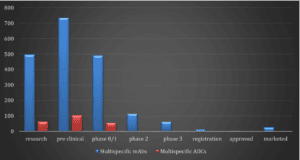
Figure 1: Multispecific mAbs and ADCS Pipeline
What are the most important analytical methods used for product release of bispecific antibodies, including bispecific antibody drug conjugates?
For any product release program, our starting point is the target product profile (TPP), since it defines the intended clinical, quality, and performance attributes. Nonclinical safety data then helps identify which product-related variants and impurities must be controlled. Being able to meet the TPP is then the driving principle behind method selection, at which point release testing falls into three broad categories.
The first covers safety-driven microbiology, such as endotoxin, bioburden, and, where applicable, sterility. The second is a physicochemical and identity panel, including protein concentration, purity by CE-SDS, aggregation by SEC, charge variant profile by cIEF, pH, and osmolality, alongside identity testing scaled to the stage of development (ranging from chromatographic or charge-based approaches early on to mass spectrometry-based methods at later phases). The third is potency, where we rely on ELISA or cell-based activity assays, again calibrated to development stage and molecule format. Across bispecific antibody products, the release/control panel also includes process-related impurity monitoring, such as HCP, residual host-cell DNA, and residual purification reagents or affinity ligands such as Protein A where applicable. For bispecific ADCs, this extends further to conjugate-specific attributes such as DAR, drug-load distribution, unconjugated antibody, free payload, and linker-payload-related impurities.
Why are these particular methods of key importance? How do they ensure efficacy, safety, quality, and consistency?
Each method addresses a particular challenge that release testing is designed to catch. Microbiology safety tests detect contamination that would render the product clinically unusable regardless of its pharmacological properties. Physicochemical methods confirm that the molecule reaching the patient matches the one characterized in non-clinical studies; the CE-SDS purity profile confirms subunit integrity, SEC aggregation data guards against forms with altered pharmacokinetics or immunogenic potential, and charge variant profiling monitors post-translational modifications that can affect binding or Fc function.
For bispecific formats, ELISA design choices have an impact. A single-antigen binding assay confirms that one arm is functional but says nothing about the other, and a molecule with a compromised second arm passes undetected. The more informative approach uses a dual-binding ELISA, in which the capture reagent is one target antigen and detection is mediated via the second, rather than relying on anti-drug antibodies, so the signal depends on the molecule engaging both antigens simultaneously. When designed well, the assay enriches signal for correctly assembled molecules, reducing the risk of passing a product with a compromised arm. For bispecific ADCs, DAR testing and free-payload analysis extend the panel further, helping to confirm the conjugate chemistry hasn’t degraded in ways that alter the therapeutic index.
How do these methods fit with regulatory expectations? What is the state of regulatory guidance for bispecific antibody final product analytics?
Bispecific antibodies are regulated within the general biologics framework, but they also have format-specific regulatory expectations. ICH Q6B supports specification setting for biological and biotechnological products, including identity, purity, impurities, quantity, and potency; ICH Q2(R2) covers analytical validation; and ICH Q14 supports risk-based analytical procedure development, including analytical target profile (ATP)-based method design. FDA has also issued bispecific antibody development guidance with quality and CMC considerations.
However, there’s no widely adopted guideline dedicated solely to final drug-product release testing for bispecific antibodies, so applicants need to justify the release panel against the molecule’s structure, mechanism of action, and critical quality attributes (CQAs). The rationale for which methods are included, and at what sensitivity, has to be explicitly defended in the CMC package. Regulatory agencies have shown a willingness to accept fit-for purpose approaches during early clinical phases, but methods are typically expected to increase in specificity and stringency as programs advance toward BLA or MAA submission. For bispecific ADCs, there are additional expectations around conjugate characterization that go beyond standard biologic lot release, drawing on precedents from the ADC field.
What are the main limitations of these methods?
In the release setting, standard CE-SDS and SEC methods were originally optimized largely in mAb contexts. They detect size-based variants well, but can be limited for asymmetric formats with multiple subunits, where incorrect heavy-chain or light-chain pairing can generate species that are similar enough in size, charge, or electrophoretic behavior to evade conventional release assays; chain mispairing is a distinct problem that these methods were not originally designed to resolve.
Potency assays present a different set of challenges. A dual-binding ELISA addresses the arm functionality question efficiently, but the most rigorous confirmation of bispecific activity requires a cell-based assay in which both targets are engaged simultaneously. These assays are substantially more demanding to develop and validate than their mAb equivalents (cell model selection, receptor density, intracellular trafficking, and assay dynamic range all require careful optimization) and the path from a research-grade assay to a GMP-validated release method can be a long one. The biological variability in cell-based systems also makes reproducibility harder to demonstrate across sites and operators.
Process impurity methods also face throughput and sensitivity constraints that become acute in a release setting, since turnaround time is finite and available sample volume is limited.
Are there any new or improved methods in development designed to address these limitations?
For chain mispairing, a big issue comes from bispecific release, but the field is pursuing two main solutions. The first is optimization of existing chromatographic methods. Reverse-phase HPLC can, with careful method development, achieve resolution between correctly assembled bispecific and mis-paired species. Charge variant assays such as cIEF or icIEF can contribute where mispairing produces a detectably distinct charge profile, which depends on the isoelectric point (pI) difference between the mismatched chains and is therefore format-specific. Enzymatic digestion steps that generate discrete Fc and Fab fragments prior to separation improve resolution further by reducing the molecular complexity the chromatographic system must discriminate. These approaches are compatible with release environments and can, in principle, be validated for lot release.
The second is mass spectrometry. Intact and subunit-level MS provides high-confidence mass based structural confirmation and can detect mispairing with high sensitivity. In development and extended characterization settings, MS is increasingly routine. Its translation to release is constrained by throughput, cost, and the validation requirements of cGMP environments, but for complex bispecific formats, the argument for including MS in extended characterization panels, if not routine release, is strong.
What are best practices and strategies for ensuring the development and application of effective analytics for bispecific antibody final products?
The most consistent predictor of a well-functioning release program is the quality of the analytical groundwork established early in development. At the center of this are TPP and the ATP. The TPP defines what the molecule needs to achieve therapeutically, while the ATP translates that into the quality attributes and the assay requirements that will confirm each clinical batch meets the standard set by the tox program. Building this documentation early, before release methods are designed, encourages teams to develop methods against defined acceptance criteria rather than qualifying methods against the product they happen to be able to make. For bispecifics specifically, this means identifying subunit pairing fidelity as a CQA before selecting the methods to monitor it, not after.
A phase-appropriate philosophy is also essential. Early clinical programs can’t sustain the full release panel of a BLA submission, but the methods developed at Phase 1 should be designed to evolve, not be replaced. Selecting methods with a credible path to validation avoids the analytical rebuilds that regularly delay commercial filings.
Is there anything else PharmaCircle readers should know about analytics for bispecific antibody final product release?
First, the distinction between release testing and extended characterization matters. Release testing confirms batch conformance against pre-set specifications, while extended characterization gives the deeper molecular understanding, since it offers information on structural integrity, post-translational modification profiles, comparability data, which support regulatory submissions and underpin process changes. For bispecifics, where chain mispairing and subunit assembly are genuine risks, the extended characterization program is essential as it’s the body of evidence that regulators will examine when assessing whether the release panel is fit for purpose.
Second, potency assay design for bispecifics needs early strategic investment. A cell-based assay that simultaneously engages both targets and can detect the loss of either arm is scientifically rigorous but analytically demanding. Building that assay in early development, qualifying it progressively, and accumulating the historical performance data that supports GMP validation is a multi-year undertaking. Teams that start late face the specific risk of entering Phase 3 with a release assay that doesn’t quite meet the validation standard expected at BLA.
Access the article here
The post PharmaCircle: Analytical Q&A on methods for Bispecific Antibodies appeared first on Abzena.